AI Initiative in Classrooms
AI Initiative in Classrooms
AI Initiative in Classrooms
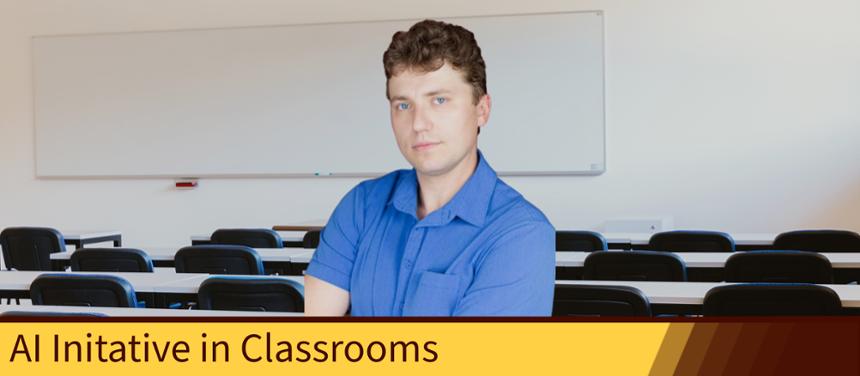
Due to the exponential growth of artificial intelligence, or AI, the Computer Science Department wants to prepare their students to learn how to utilize AI to the best of its capabilities. Professor Weidner, an Assistant Teaching Professor, is leading the AI initiative within the department. This plan asks: How can we use Generative AI in the classroom? How can we introduce it in a classroom so that we can prepare people for the industry? Furthermore, if students want to utilize AI, how should professors teach AI in a way that sets them up for success?
Professor Weidner teaches advanced programming workshops, but his bread and butter is game development. In his classroom, he encourages his students to use AI to understand topics, assist studying, or to generate simple code that may take a long time to write. On the other hand, as a professor, AI helps him turn slideshows into text, generate code, and generate questions for his paper quizzes, which is incredibly helpful when he needs a diversity of questions each semester to combat cheating.
When it comes to coding, Professor Weidner acknowledges that Generative AI has gotten more proficient at developing code, and he is still experimenting to test out the extent of AI’s coding capability. However, while he encourages his advanced programming students to generate basic code to save time, he strongly advises against students or professors implementing AI in beginner classes like Intro to Object-Oriented Programming. Although code generation has gotten better, AI is still known to create false information, and it is up to the student’s discretion to know right from wrong. The Game Development Professor states, “you kind of have to recognize that this thing could lie to you at any time.” Moreover, students need to know the basics in order to fully understand their code before using a resource like AI. Weidner says, “If you went into a classroom with a bunch of fourth graders and taught them basic math, then you just go, here's the calculator, you're setting them up for failure. They can't move on after that.” Professor Weidner also emphasizes to his students, “Don't use AI as a means to cheat. Use this as a means to make your life easier when learning how to do something.”
Professor Myers, another Computer Science professor, is also furthering his students’ understanding of AI in his Databases and Object-Oriented Programming and Data Abstraction (OOPDA) class. In OOPDA, his students had to create a project that AI develops, testing the full extent of AI’s capabilities. While working on the project, the students are tasked to understand, oversee, and correct the AI, meaning the students must comprehend the theory and design structure behind the code that the AI produces. One of Professor Myers’ OOPDA students, Michael Merin, says that AI “allows teachers to come up with more innovative practice work and presentations, and can be easily adjusted to the classes' learning pace as a whole. This can make lessons feel much more engaging and allows all students to pick up information instead of leaving slower learners behind.”
Regarding the future of AI, Professor Weidner admits that “people are not too sure about the future of AI.” Despite this, he doesn’t think AI will replace programmers – “In fact, it will need more people.” One of the main reasons he is currently pursuing the AI initiative in classrooms is that the tech industry expects people to use AI, and it’s vital that students learn how to use and understand AI properly. Despite the uncertainties, Professor Weidner affirms that AI is now a resource for us to use. “We have libraries, we have the internet. Now, we have ChatGPT.”
Written by Cassandra Marie Nicdao | Posted 04.22.26